The Critical Role of Workforce Skills in Central Europe’s Clean Energy Future
An analysis of job posting data from Austria and Germany reveals which skills and occupations are shaping the energy transition, and where the gaps are widening.
Europe’s clean energy transition is accelerating, but the workforce to deliver it is not keeping pace. Across Austria and Germany, two countries at the heart of the continent’s
Energiewende, employer demand for skilled energy workers has surged even as unfilled vacancies climb to record levels. An analysis of job posting data from these markets, conducted by labor market intelligence start-up Julius (juliusedu.com), paints a clear picture: the transition will be successful when skills are centered.
Germany alone needs an estimated 350,000 additional skilled workers by 2030 to plan, build, and operate renewable power and hydrogen production facilities. Austria has responded to its own shortages by adding over a hundred new occupations to its official skill shortage list for 2025, with electrical engineers and renewable energy planners prominently featured. At the EU level, the International Energy Agency reports that roughly 60% of energy companies now face labour shortages, putting project timelines, system reliability, and cost control at risk.
Julius specialises in helping workers transition into future-oriented industries like clean energy and critical materials. By analysing millions of job postings across Austria and Germany from September 2023 through late 2025, Julius has mapped the occupations and skills most in demand, and shown how hiring trends have moved in lockstep with Europe’s shifting energy landscape.
A Market Under Pressure: The Overall Hiring Landscape
Between late 2023 and early 2025, clean energy-related job postings across Austria and Germany underwent a dramatic expansion. The data shows postings climbing from fewer than 2,000 job postings in January of 2024 to a peak of roughly 35,000 in January 2025, a surge closely tied to the policy environment and geopolitical pressures reshaping Europe’s energy sector.
The initial ramp-up from late 2023 through spring 2024 coincides with the EU’s accelerated implementation of REPowerEU, the strategy launched in May 2022 to end European dependence on Russian fossil fuels. By this period, Russian gas imports had fallen from 45% of the EU supply in 2021 to roughly 19% in 2024, and the mandate to replace that capacity with renewables was translating directly into hiring. Austria’s own target of covering 100% of electricity consumption from renewables by 2040 added further urgency.
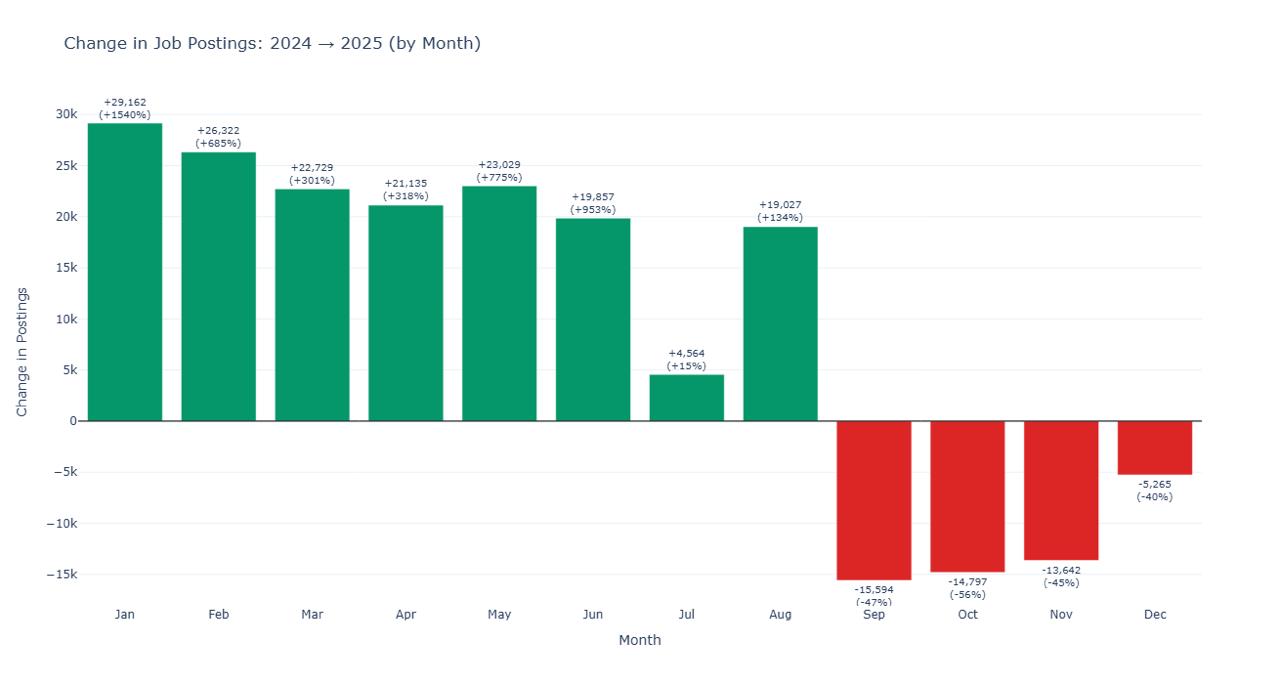 Figure A: Change year-to-year of clean energy-related job postings from Austria and Germany expose the changing demand for clean energy roles.
The sharp jump visible around mid-2024 aligns with several converging forces. The EU electricity market reform entered into force in July 2024, designed to make energy bills more independent of short-term market prices and to accelerate the integration of renewables. Germany simultaneously expanded its building renovation programme, adding 335,000 individual renovation measures backed by €6.2 billion in funding. These policy catalysts translated almost immediately into demand for electricians, engineers, and technical specialists.
The peak in January 2025 and subsequent plateau through mid-2025 reflect the period when many of these projects moved from planning to execution. Austria’s 23% increase in grid fees, effective early 2025, underscored the need for grid expansion and modernisation, work that requires precisely the technical workforce these postings seek to attract. The eventual decline in the latter half of 2025 likely reflects both seasonal hiring patterns and the broader economic headwinds affecting Germany’s labour market, where the economy saw stagnant or minimal growth.
Figure B: Interactive plot for top 100 roles in clean energy.
The Occupations Driving Demand
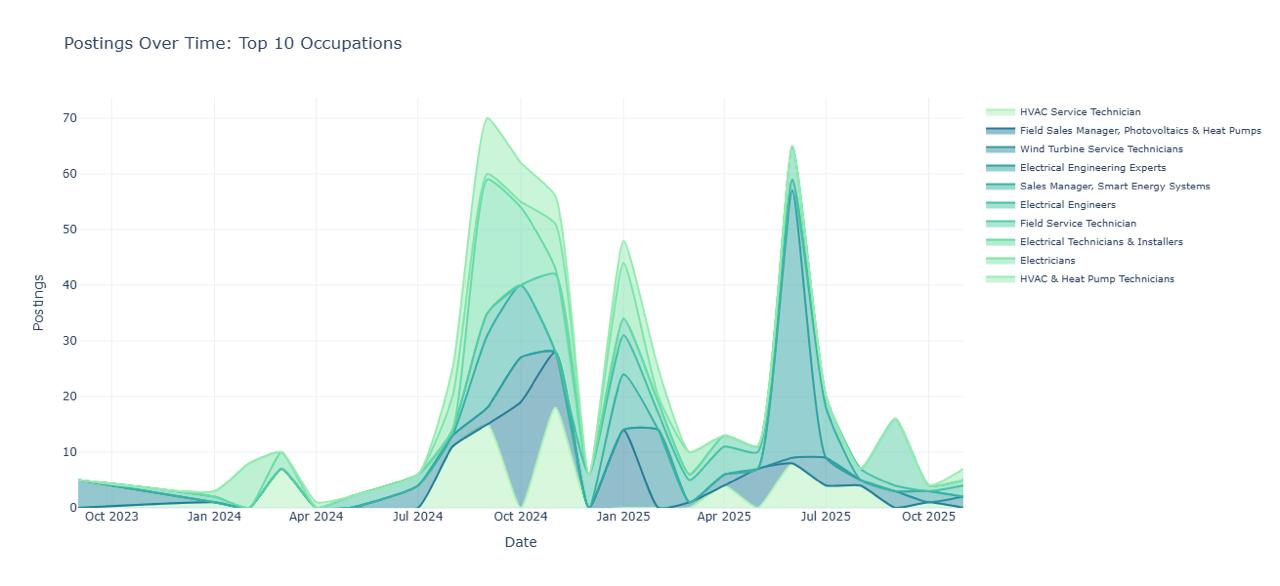 Figure C: The top 10 occupations in demand in a sample of data from Austria and Germany related to clean energy.
Disaggregating the data by occupation reveals which roles are bearing the heaviest burden of the transition. Julius’s clustering methodology groups raw job postings into standardised occupation categories, making it possible to track demand for specific roles over time even when employers use varying job titles.
Electrical Engineering Experts consistently rank among the most posted occupations across the full time period, with postings climbing from single digits in early 2024 to a peak in June 2024 before settling into a sustained band of 28 to 45 postings per month through 2025. This aligns with Germany’s KOFA analysis, which found that electrical engineering accounted for over 14,200 unfilled vacancies in 2024, a 10% increase over the prior year.
Electricians show a particularly striking pattern. Postings held steady at modest levels through most of 2024, dipped around September, then surged in January 2025. This spike directly mirrors the wave of grid expansion, EV charging infrastructure deployment, and building electrification projects that came online as REPowerEU investments reached the construction phase. The German Economic Institute has identified construction electricians as the single largest bottleneck in the country’s energy transition workforce, noting that these workers are indispensable for the planning, installation, and maintenance of wind and solar systems as well as charging infrastructure for electric vehicles.
Wind Turbine Technicians show steadier, more gradual growth, consistent with the longer project timelines of wind farm development. Postings climbed in January 2024 to triple by January 2025, reflecting the EU’s push to scale offshore and onshore wind capacity. The European Investment Bank’s €5 billion wind energy package, designed to catalyse €80 billion in wind farm investments and enable 32 GW of new capacity, has been a key driver.
Though not included in the figure above, we saw an increase in postings for Engineering Interns, which presents an interesting signal about supply development. Postings for intern roles increased sharply in November 2024, suggesting that employers are investing in developing future talent even as they struggle to fill current vacancies. This is a forward-looking indicator that the industry recognises the skills gap as structural rather than cyclical.
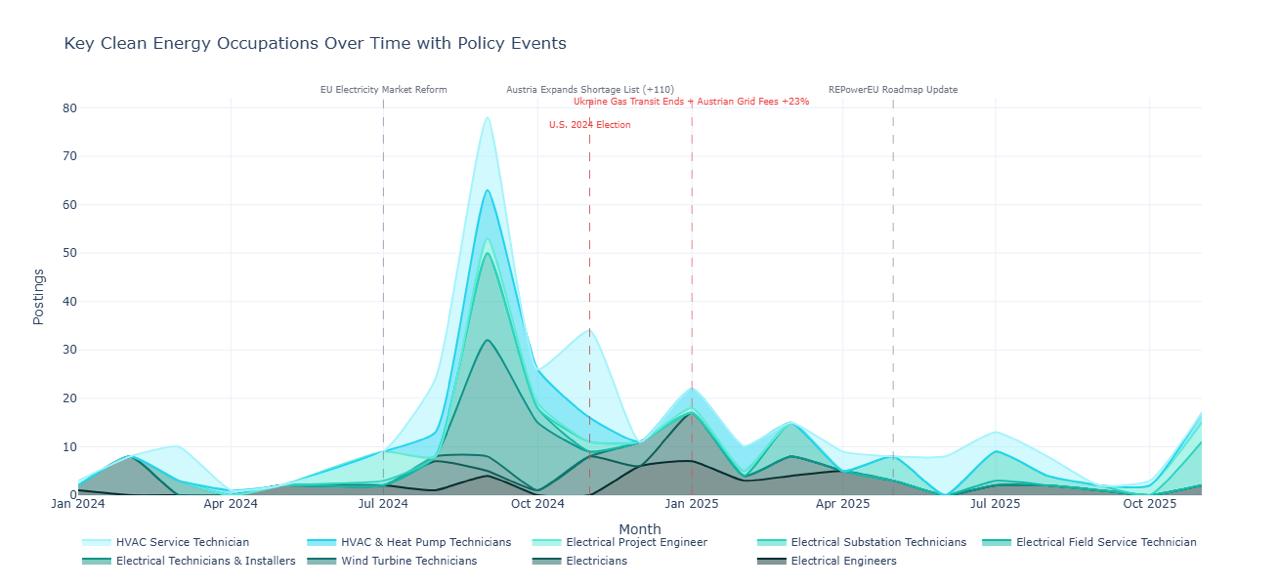 Figure D: Key occupations that help push the clean energy transition in Europe forward, such as HVAC and Electrical roles. We see a massive increase after the EU Electricity Market Reform and a decrease after the U.S. 2024 election and grid price increase.
The Skills That Matter Most
Figure E: Skill demand over time often correlates with job demand. The type of skill exposes the greatest skill needs in the economy.
Looking beyond job titles to the specific skills employers are requesting reveals the technical DNA of the energy transition. Julius’s skills extraction pipeline analyses the full text of each job posting to identify granular technical competencies, then filters out generic soft skills to surface the capabilities that genuinely differentiate clean energy roles from the broader labour market.
Electrical Knowledge dominates the skills landscape, peaking at over 300 mentions per month in late 2024. This reflects the reality that electrification of transport, heating, and industry is the common thread running through nearly every aspect of the energy transition. Whether the role involves installing solar panels, maintaining wind turbines, or building out grid infrastructure, electrical expertise is the foundational requirement.
Heat Pump Knowledge has emerged as a notably rising skill, climbing steadily from near-zero in early 2024 to consistent demand through 2025. This tracks the EU’s target of deploying 10 million cumulative heat pump units between 2023 and 2027 under REPowerEU. Despite a 23% sales dip in 2024 due to high costs and policy uncertainty, early signs of recovery appeared in 2025, with sales rising 9% in the first half of the year. The ongoing demand for heat pump skills in job postings suggests employers are building capacity in anticipation of this recovery.
SAP expertise appears prominently across energy sector postings, reflecting the enterprise-scale operational complexity of modern energy companies. As utilities manage dynamic pricing, smart grid operations, and complex regulatory compliance, the need for workers who can navigate large-scale enterprise systems has become a consistent feature of the sector’s skill demands.
Environmental Compliance and Standards Compliance skills show sustained demand throughout the period, driven by the increasingly dense regulatory environment surrounding Europe’s energy transition. Austria’s pending implementation of dynamic grid fees, the EU’s updated National Energy and Climate Plans, and the European Building Directive’s requirements for EV-charging readiness in new buildings all create demand for workers who understand the regulatory landscape.
Construction Management rounds out the top skills, reflecting the physical reality that the energy transition is fundamentally a construction project: installing solar panels, erecting wind turbines, laying cables, and retrofitting buildings at continental scale.
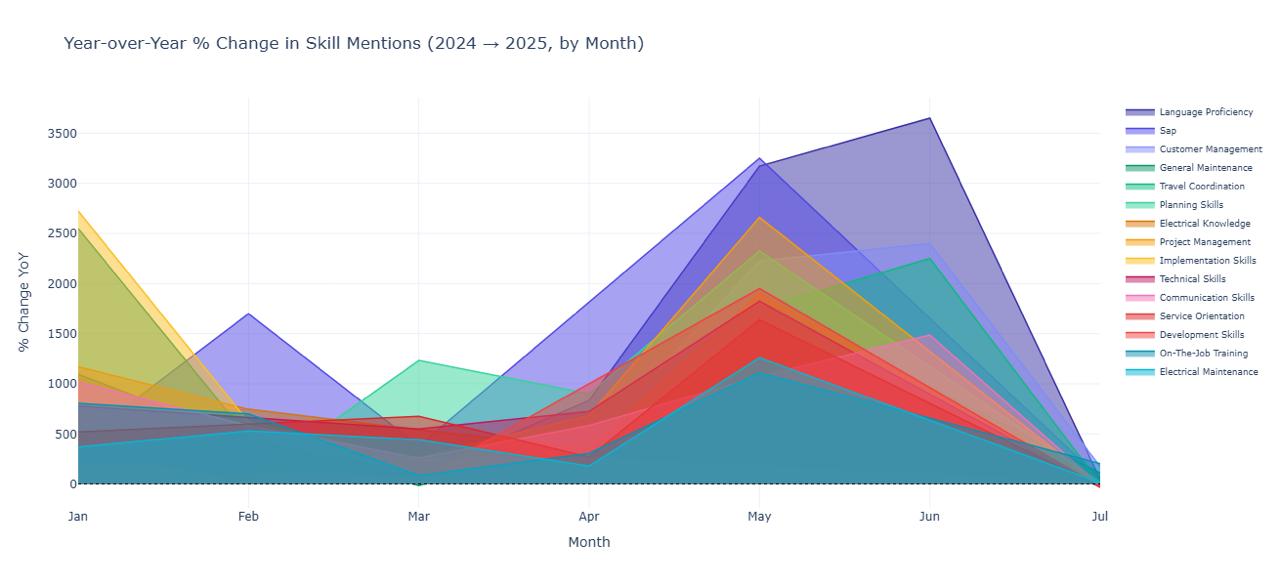 Figure F: The change in demand of skills over time.
The European Context: Policy Drives Demand
The patterns visible in this data do not exist in isolation. They reflect the cascading effects of Europe’s most significant energy policy shift in a generation.
The end of Russian gas transit via Ukraine, which reduced pipeline gas imports by 15 billion cubic metres per year, created an immediate acceleration in demand for renewable energy infrastructure and the workers to build it. Austria, which generates over 75% of its electricity from renewables (predominantly hydropower), is better positioned than many European peers, but its ambitious 2040 target still requires massive grid modernisation and new capacity.
Germany’s situation is more acute. Despite its status as Europe’s largest economy, it faces a labour market where energy transition job postings have more than doubled since 2019, now accounting for nearly 4% of all job offers nationally. Solar-related postings alone climbed from 41,500 in 2019 to 102,000 in 2024, while wind energy roles grew by approximately 70% to nearly 53,000 positions. Yet the supply of qualified workers is not keeping up: over 200,000 STEM-related vacancies remain unfilled.
At the EU level, the skills mismatch is structural. According to LinkedIn data, European job postings requiring green skills rose by over 22% in a single year, while the supply of workers with those skills increased by only 12%. The IEA notes that technical vocational graduations grew by only 9% between 2015 and 2022, while economy-wide demand for applied technical workers grew by 16%. The energy sector, which relies on applied technical roles for over half its workforce, is feeling this gap acutely.
Bridging the Gap: How Data Can Light the Way
Understanding the scope and shape of the skills gap is a prerequisite for closing it. Traditional approaches to labour market intelligence, such as periodic government surveys or anecdotal employer feedback, are too slow and too coarse to guide real-time decisions about training investments and curriculum design.
Julius addresses this by building data pipelines that continuously ingest, deduplicate, and enrich millions of job postings across multiple sources, while considering changing political and policy landscapes. The result is a living picture of what employers actually need, updated as fast as the market moves.
For policymakers, consistently updated labor models reveal where training investments will have the highest impact. For educational institutions, they show which curricula need updating and which emerging skills deserve dedicated programmes. For workforce development agencies and professional associations, it identifies which workers in adjacent industries already possess transferable skills and could transition into clean energy roles with targeted upskilling. And for the workers themselves, it ultimately illuminates concrete pathways into vital sectors, such as clean energy.
The analysis presented in this article is one example of this approach in action. By connecting job posting data to real-world policy events, Julius helps stakeholders move from broad awareness that a skills gap exists to specific, actionable intelligence about which skills, in which occupations, in which regions, are most urgently needed.
What This Means for the Clean Energy Workforce
Labor market information from Austria and Germany carries implications that extend well beyond Central Europe. These two markets are leading indicators for the continent as a whole, and the patterns they reveal suggest several key takeaways.
First, the skills gap is structural, not cyclical. The sustained and growing demand for electrical, construction, and renewable energy skills, even during periods of broader economic softness in Germany, indicates that this is a long-term workforce challenge requiring systemic solutions, not temporary hiring surges.
Second, the transition demands a blend of traditional and emerging skills. Electrical knowledge and construction management remain foundational, but they are increasingly paired with newer requirements like heat pump expertise, energy management systems knowledge, and environmental compliance. Workers who can bridge these domains will be the most valuable.
Third, the intern and entry-level hiring data suggests governments should invest in pipeline development. But the pace is insufficient. Austria’s Just Transition action plan, which aims to reskill 1,000 people for environmental sector roles, and Germany’s National Skills Strategy represent important steps, but the scale of these programmes remains far below the hundreds of thousands of workers needed.
Finally, international recruitment is becoming essential. Both Austria and Germany have expanded immigration pathways specifically for energy-sector workers. Austria’s Red-White-Red Card system now explicitly fast-tracks electrical engineers, renewable energy planners, and photovoltaic technicians. Germany’s KOFA report notes that recruiting international skilled workers represents one of the greatest untapped potentials for closing the gap. The kind of skill worker being recruited is important, though. Julius’ data shows a high demand for HVAC and electrical professionals, and not just those with graduate degrees. A refocus on skill trades would improve the EU’s energy transition goals.
Conclusion
The clean energy transition in Austria and Germany is no longer an ambition. It is an active project, and it is running short of builders. The job posting data analysed here shows that employer demand has surged in direct response to Europe’s policy commitments, from REPowerEU through to national grid modernisation programmes. But the workforce to deliver on these commitments is not materialising at the pace required.
The occupations in highest demand, including electricians, electrical engineers, and wind turbine technicians, are the same roles identified as critical shortages across the EU. The skills most sought after, from electrical knowledge to heat pump expertise to environmental compliance, map directly to the physical infrastructure of the energy transition. And the gap between the demand for these workers and the supply of qualified candidates is widening, not closing.
Addressing this gap will require coordinated action across education, immigration, and industrial policy. Vocational training programmes must be expanded and aligned with the specific technical requirements employers are signalling through their job postings. International recruitment pathways must be streamlined. And the energy sector must compete more effectively for talent in a tight labour market by offering competitive wages, job security, and clear career pathways.
The data is clear: Europe knows what skills it needs. The question is whether it can develop them fast enough. Organisations like Julius and the Energy Bridge are working to ensure the answer is yes, by turning millions of data points into the actionable intelligence that policymakers, educators, and workers need to close the gap before it becomes unbridgeable.
This analysis was produced by Julius (juliusedu.com), a workforce analytics organisation that helps US-based and international workers transition into future-oriented industries including clean energy, critical materials, and advanced manufacturing. To learn more about Julius’s workforce intelligence capabilities or to explore partnership opportunities, visit juliusedu.com.
Sources
Clean Energy Wire, “Energy transition requires 350,000 additional skilled workers in Germany by 2030,” December 2024.
Work in Austria, “Nationwide shortage occupations,” Austrian Immigration Department.
International Energy Agency, “World Energy Employment 2025: Executive Summary,” 2025.
European Commission, “REPowerEU: 3 years on,” 2025.
European Commission, “Recovery and Resilience Facility for clean energy,” 2025.
Clean Energy Wire, “Electricians, engineers most needed professions for German energy transition workforce: KOFA analysis,” February 2025.
European Investment Bank, “REPowerEU and the EIB,” 2025.
EHPA, “REPowerEU and the EU Heat Pump Action Plan”, 2024.
SSA Ltd, “Recruitment Trends in Germany’s Renewable Energy Industry 2025”, 2025.
InnoEnergy, “Scaling Europe’s Green Skills,” 2025.
European Parliament, “Austria’s climate action strategy,” EPRS Briefing, 2024.
DGAP, “Green-skilled Workers for the Future,” Policy Brief No. 19, November 2025.
Add in interactive plot
Interactive graph, if possible